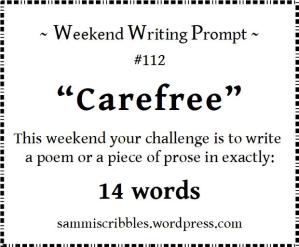
I remember you tiny,
barely a handful
yet fully formed.
Face screwed
into a perfect grimace.
So put out
that you were here
again
to do this all over
with this
unimpressive lot.

I remember you tiny,
barely a handful
yet fully formed.
Face screwed
into a perfect grimace.
So put out
that you were here
again
to do this all over
with this
unimpressive lot.

This weekend the NYC Midnight Flash Fiction Challenge is taking place. Last month I posted my entry for the second challenge of the first round: Stolen Silence and at the moment I’m working on redrafting my submission for the first challenge of this year’s first round.
Redrafting is the part of the process where you quite often find yourself doubting that you have any ability to put one work in front of the other at all. You find typos, spelling mistakes, words that you didn’t even know existed. Tenses switch back and forth, character names suddenly change, and out of nowhere you move from mountains to city surroundings. Editing is where all your mistakes come to the forefront and you have to go back and fix them.
If you’re luck you will have brilliant people who will help you with your redrafts and edits. These people (if you can find the ones that will give you an honest review rather than just ‘yeah mate, good job’) are invaluable for getting your past that snow-blind stage where you can’t see the words for the prose. Distance from your work can help, but I often find a fresh pair of eyes will pick apart of poem or story far more effectively than I ever could.
I’ve been very luck, I’ve always had friends who were interested in reading and writing so I’ve always had people to run work past. At the moment there is someone reading my poetry collection ‘All In The Blood’ for me, and someone else who has been giving feedback on my NYC submission. For both it has been less about being told what is wrong with my writing, or what is right, but about being challenged to look at my work through a different lens. More often than not this means I go back and take another shot at saying whatever it was I was trying to say.
So, my top tips for editing and redrafting.
Now, enough procrastinating, I have a story to redraft, a poetry collection to edit, and a novel to corral. As they say, no sleep for the writer.



It’s an odd moment
when you recognise
his fingers for pins
pressed through
your skin,
and into the wall
behind.
Must be the same
panic,
as an insect
caught up
in spider silk.
Not all shimmer
is gold.
Too late
to be free
without loosing
something
perhaps all
of you, yourself,
in the struggle.

You shed it all
despite my begging,
and became so light
I lost you.


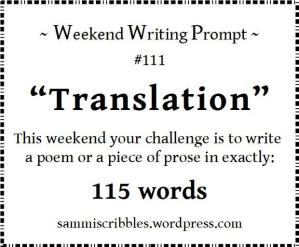
In some cases, the letter won’t translate.
Specified language is always a little tricky,
not like asking
for directions to the swimming pool,
or how much for the loaf of bread
behind the counter.
You craft an art-form of assumptions.
Cut loose the odd words,
ones which clearly don’t fit
in the rigid confines of business,
ones surely not meant.
Leave a framework of mundane.
Puzzle a meaning from the scraps,
a rhythm for the found poem
butchered out of miscommunication.
Send a response in English,
cringe a little for the recipient,
know they will likely do as you
and turn to an app,
a browser tab,
punch in the words,
frown at the nonsense.

 Carol J Forrester
You must be logged in to post a comment.